UC San Diego Ranks No. 4 Among U.S. Public Universities: What It Means for San Diego Families
Short answer: UC San Diego's No. 20 global ranking and No. 4 position among U.S. public universities do not tell parents which K-12 school is right for their child. They do show that San Diego has a world-class network of research, talent, and industry. For Chinese families comparing local public and private schools—or planning a US-born child's return to the U.S.—that network is an important signal about the city's educational ceiling.
On September 3, 2026, UC San Diego announced its latest result in the Academic Ranking of World Universities (ARWU): No. 4 among U.S. public universities, No. 14 among all U.S. universities, and No. 20 worldwide.
The numbers are impressive. But if families only remember “No. 20 in the world,” the news will soon disappear beneath the next ranking.
At EdCommGlobal, we think the more useful question is this: what does a top-20 research university contribute to the city around it? What does it mean for a child already attending school in San Diego, preparing to move here, or considering the city as part of a long-term education plan?
First, understand what ARWU measures
University rankings answer different questions.
ARWU evaluates more than 2,500 institutions each year and publishes the top 1,000. Its six indicators focus on Nobel Prize and Fields Medal recipients among alumni and faculty, highly cited researchers, papers published in Nature and Science, papers indexed in major science and social-science citation databases, and per-capita academic performance.
In other words, the ranking primarily measures whether a university produces high-level research over time. It does not primarily answer whether campus life suits a particular student, how supportive an undergraduate classroom feels, or how difficult admission will be.
UCSD's No. 20 ranking cannot make a school-choice decision for a family. It can confirm something important: San Diego is home to a university with research output and academic talent at the highest international level.
Behind the ranking: one alumnus's story
UCSD's ranking announcement highlights alumnus Fred Ramsdell.
Ramsdell graduated from UCSD in 1983 with a degree in biochemistry and cell biology. In 2025, he shared the Nobel Prize in Physiology or Medicine with Mary Brunkow and Shimon Sakaguchi for discoveries explaining how the immune system avoids attacking the body's own tissues.
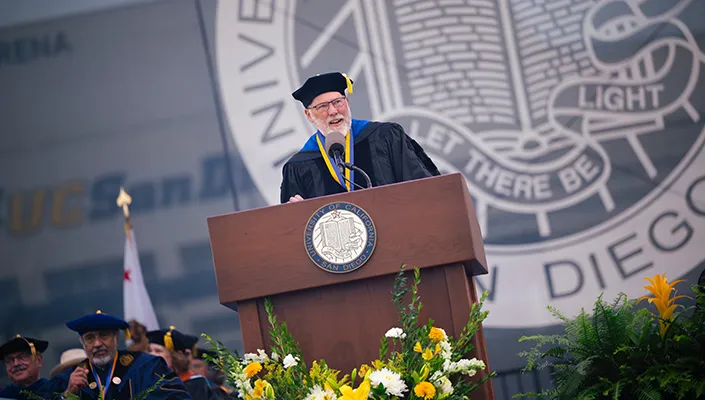
Nobel laureate and UC San Diego alumnus Fred Ramsdell returned for All Campus Commencement in June 2026. Photo: Erik Jepsen/UC San Diego.
Ramsdell later recalled that he did not begin with a carefully mapped route to a Nobel Prize. An immunology course at UCSD first drew him deeply into the field. After disagreeing with the grading of an exam question, he spent two hours debating it with his professor. What stayed with him was the scientific exchange.
That detail says more than the label “Nobel alumnus.” Sometimes an educational resource is not one more class. It is having someone willing to keep discussing a question after a student challenges an answer.
UCSD's recent recognition is not limited to the life sciences. Scripps Institution of Oceanography professor emeritus Farooq Azam received the Kyoto Prize for his work on the microbial loop. Daniel M. Kane received the 2026 Gödel Prize in theoretical computer science. Philosophy professor Nancy Cartwright received the 2026 BBVA Foundation Frontiers of Knowledge Award. Literature professor Brandon Som, a Pulitzer Prize winner in poetry, received a Guggenheim Fellowship in 2025.
Ocean science, immunology, computer science, philosophy, and poetry all coexist at one institution. That is a more accurate picture of UCSD than simply saying it is “strong in STEM.”
A research university is part of a city's knowledge infrastructure
If university research never moves beyond papers and awards, it can feel distant from K-12 students. UCSD matters locally because some of its research is being tested against real problems.
The San Diego Supercomputer Center is the testing ground for an $8.48 million California Energy Commission-funded project on new power architecture for AI data centers. The goal is to reduce energy waste and cost while improving grid reliability. A university facility becomes a real-world test site for new technology.
Another path runs from the laboratory to the clinic. Catriona Jamieson's team at the Sanford Stem Cell Institute developed the investigational drug rebecsinib and sent related cancer experiments to the International Space Station. A UCSD clinical trial is now studying the drug in two blood cancers.
Most K-12 students will not encounter these projects directly. But the projects make terms such as artificial intelligence, energy systems, cancer research, and space experiments less abstract. People nearby are doing this work, supported by universities, research institutes, hospitals, and companies.
When families discuss San Diego education, they often focus on districts, courses, AP offerings, and college outcomes. Those matter. A city's educational ceiling also depends on the universities children can see, the questions being investigated around them, and whether they can gradually find a path toward those questions.
How K-12 families can turn “UCSD is nearby” into a real resource
The boundary matters: living near UCSD does not create automatic access to a laboratory. Attending high school in San Diego does not make admission to UCSD easier by itself. A university ranking cannot replace an evaluation of a child's fit with a particular school or course plan.
The practical value is to use the university as a window into subjects and careers.
When visiting campus, take fewer landmark photos and ask more specific questions. What are people researching here now? What does daily work in a field actually look like? If a student becomes curious about ocean science, immunology, data, or philosophy, what course, book, or small project would make sense next?
Families can ask equally concrete questions about study tours, summer programs, and extracurricular activities. Will the student engage with a real issue? Who will guide the work? What will the student produce? If the entire experience is described as “visiting a famous university” and “feeling the atmosphere,” the institution may remain distant from the child.
Strong education planning does not force a teenager into an early major. It creates enough specific exposure for “I think I like science” to become “I want to understand the immune system better.” It also leaves room for the student to discover a stronger interest in writing, public policy, or something else.
A ranking is a clue, not an answer
UCSD's No. 20 global position is worth celebrating. For families, it is also a clue: beyond San Diego's coastline, climate, and well-known school districts, the city has a system that continually produces new knowledge.
How much a child gains from that system is not determined by ZIP code alone. Parents and educators still need to help the student find a realistic path toward it.
That is the part of San Diego's education story EdCommGlobal most wants families to understand.
For Chinese families exploring San Diego schools
After considering a city's educational foundation, families still face concrete decisions. Is a public or private school a better fit? Which district matches the child's current grade and learning needs? When should private-school applications begin? For a US-born child returning from China, when should the move happen, and how should the family plan for courses, English, and daily life?
There is no universal answer sheet. Age, citizenship, language preparation, living arrangements, and long-term college goals can all change the right path.
If you are exploring San Diego public or private schools—especially if you are planning a US-born child's return to the U.S.—contact EdCommGlobal with the student's current grade, current city, expected enrollment date, and the question you most need to solve. We can help you identify what to verify and prepare first based on the family's actual situation and local school options.
FAQ
Does UCSD's ranking mean nearby public K-12 schools are all strong?
No. University rankings, district boundaries, and K-12 school quality are different decision systems. Public-school planning still requires families to verify residency, district rules, course offerings, student support, and individual fit.
Is it easier to get into UCSD after attending high school in San Diego?
Geographic proximity does not create automatic admission preference. UC undergraduate review still considers academic preparation, performance, context, and application materials. The local benefit is exposure to a university campus, public programs, and nearby academic questions—not an admissions shortcut.
Should a US-born Chinese student choose public or private school first?
There is no single answer. A public-school plan depends on verifiable residency, district eligibility, student independence, and family support. A private-school plan depends on application timing, cost, class size, academic support, and living arrangements. Families should compare grade level, academic English, course transition, guardianship, and budget together.
What is the easiest grade for returning to school in San Diego?
Grade 8 often leaves more time for English, math placement, social adjustment, and preparation before high-school GPA begins. It is not a rule for every family. The child's current curriculum, reading and writing level, family plan, and target-school application windows can change the answer.
Sources
The ranking and project information below was last verified on September 4, 2026:
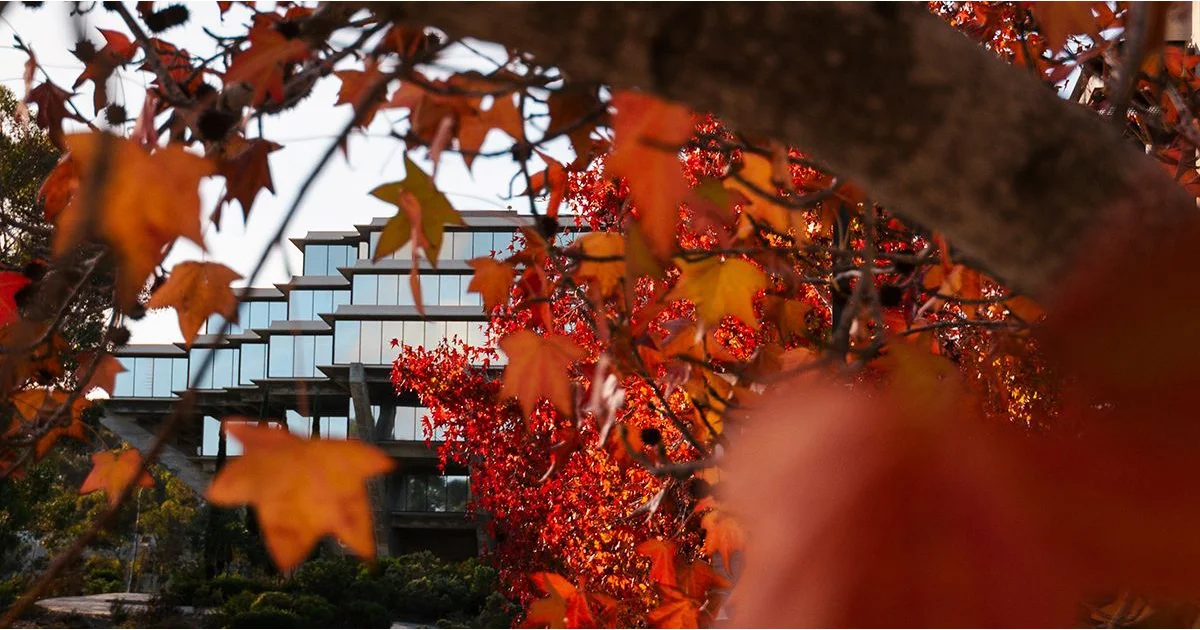
- The cover shows UC San Diego's Geisel Library in autumn; the inline image shows Fred Ramsdell returning to speak at commencement. Both images were supplied by the user and credited by the original publisher to Erik Jepsen/UC San Diego.
- UC San Diego: 2026 ARWU ranking and research highlights
- ShanghaiRanking: 2026 Academic Ranking of World Universities
- Nobel Prize: Fred Ramsdell, 2025 Nobel Prize in Physiology or Medicine
- UC San Diego: interview with Fred Ramsdell
- UC San Diego: AI data-center power technology project
- UC San Diego: rebecsinib blood-cancer clinical trial
- UC San Diego Mathematics: Daniel Kane receives the 2026 Gödel Prize
- UC San Diego: Nancy Cartwright receives the Frontiers of Knowledge Award
Related reading
Related reading
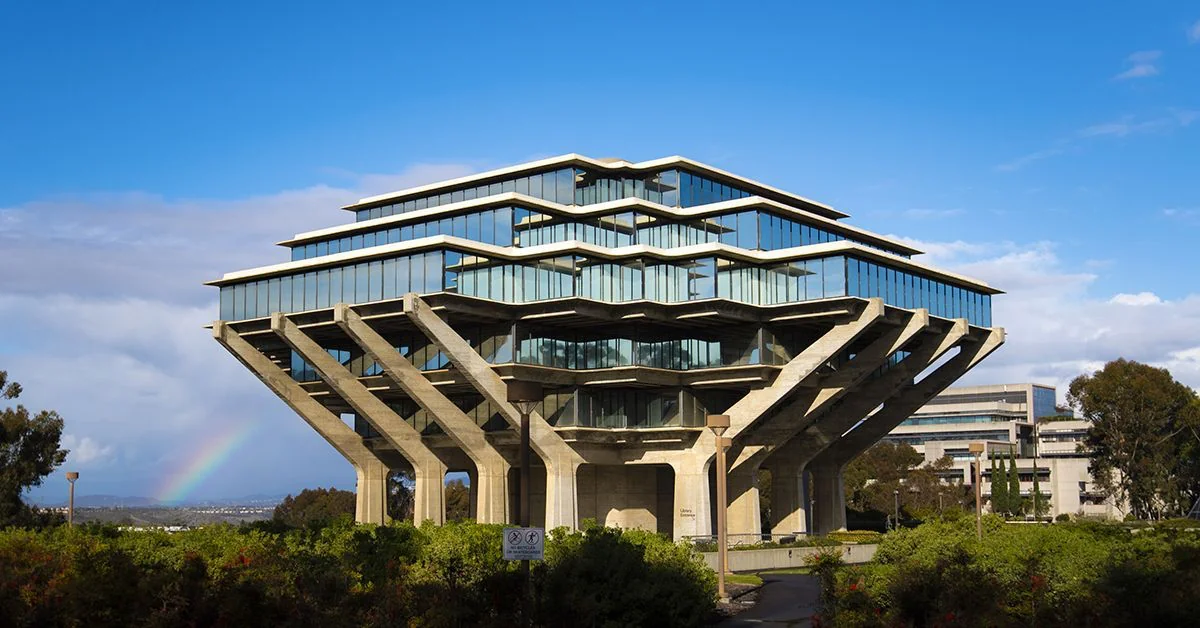
UC San Diego Is the No. 6 U.S. Public University: What the 2027 U.S. News Ranking Means for Families
UC San Diego ranks No. 6 among U.S. public universities for the fourth consecutive year, while undergraduate AI rises to No. 8 and economics to No. 12. Here is what those results do—and do not—mean for San Diego families.
UC San Diego's AI Research and Startup News: What Families Can Learn About San Diego Education
UC San Diego is leading a national AI research operations center and supporting research-based startups. EdCommGlobal explains what families can learn from these developments, with practical learning ideas and the eligibility, fees, and completed dates of the 2026 REHS high school research program.

College AI Policy in 2026: AI Literacy Requirements, AI on College Essays, and What San Diego High School Families Should Know
College AI policy is changing: SUNY now requires AI literacy for fall 2026 entrants. Can students use AI on college essays, does Common App check for AI, and what are San Diego high school AI rules? A guide for families.