UC San Diego's AI Research and Startup News: What Families Can Learn About San Diego Education

Cover: an illustration of national AI research resources. Image: NSF, via UC San Diego Today.
When choosing a school for a child interested in AI and science, parents can look beyond the course catalog. Nearby universities, programs for young people, and subjects a child wants to keep exploring are also worth investigating.
This is one reason EdCommGlobal follows education in San Diego. We want to help families understand the resources here and how they relate to a child's age, interests, and current academic preparation.
In our earlier article on San Diego as a classroom, we explored how a city can support learning. University research offers another way to approach that idea.
Two announcements from UC San Diego on September 1, 2026 are useful to read together.
The National Science Foundation awarded $35 million over five years to support the San Diego Supercomputer Center (SDSC) at UC San Diego in leading the National Artificial Intelligence Research Resource Operations Center (NAIRR-OC), in collaboration with the Texas Advanced Computing Center at UT Austin. The center will coordinate computing, data, and AI tools, alongside training and technical support for the U.S. research and education community. UC San Diego's announcement
For families exploring AI education, this opens up a useful conversation: once a child has access to a tool, what would they like to investigate?
We suggest bringing that question into everyday learning. A child interested in weather could find a public temperature dataset, chart the changes, and explain what they notice. Finding a charting tool is straightforward. Understanding the data takes more thought: where did the records come from, are there gaps, and does the conclusion hold over a different period?
An exercise like this gives parents a clearer view of the child's interests. They might enjoy programming, or prefer spotting unusual patterns and explaining them. Those observations can help a family decide what to study next.
The NAIRR-OC announcement shows UC San Diego taking on a national AI research service role. It offers families a window into local research activity. Access for K-12 students still depends on individual programs; the announcement does not promise priority access for local children.
The second announcement concerns research becoming a business. A joint incubator from UC San Diego and Bow Capital selected six companies founded by students, faculty, and alumni. Each team receives $100,000 in investment and joins a three-month, full-time, in-person program with mentoring and customer and investor connections. It focuses on dual-use technologies with defense, government, and commercial applications. UC San Diego's announcement
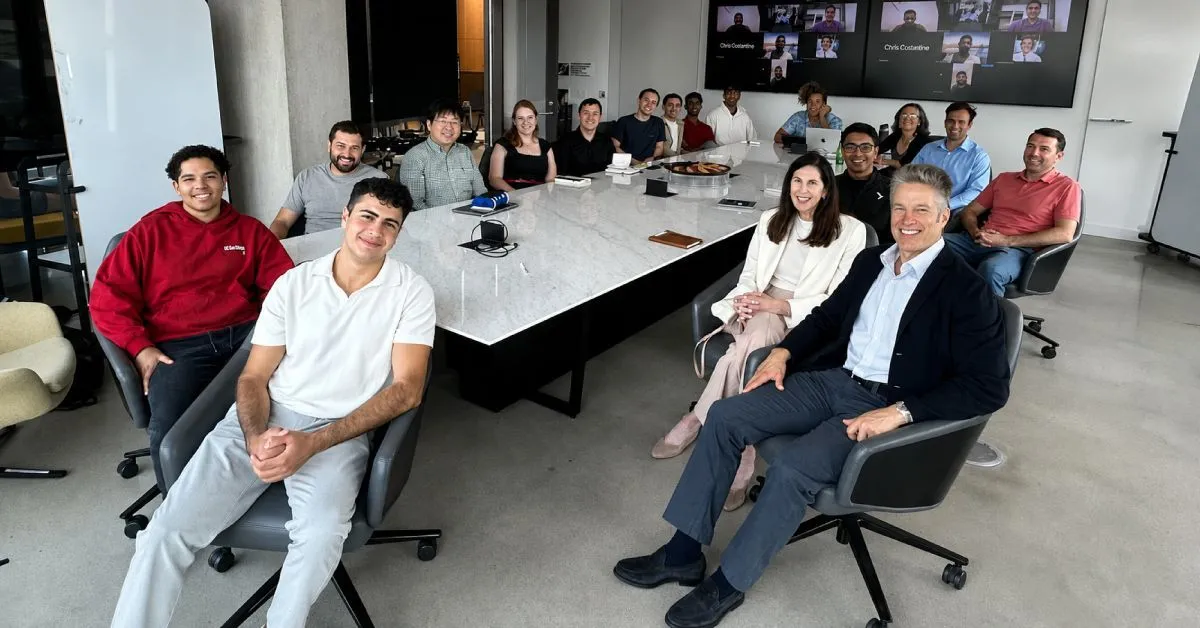
The inaugural incubator cohort at UC San Diego's Design and Innovation Building. Image source: UC San Diego Today.
One participant, Evaporion, is developing cooling technology for AI chips and data centers. Evaporion's technology overview
This is a useful example to discuss with a child. A conversation about AI can extend to the power and cooling needs of computing equipment, inviting students to connect school physics with engineering questions. A child who is less interested in coding but enjoys experiments might find a subject they want to explore through that connection.
Parents could take the discussion further: if the child designed a cooling device, how would they compare it with an existing solution? What would they measure? Why might someone choose to use it?
Even as a discussion exercise, this gives practical meaning to applying knowledge. The child needs to explain a design, plan a comparison, and understand someone else's questions. Parents can notice which part holds their attention before arranging more advanced learning.
The incubator supports selected startup teams, and the $100,000 is business investment. For K-12 families, its relevance is in exploring research and possible fields of study. Opportunities for young people require a separate look at specific programs.
SDSC already runs a high school Research Experience for High School Students program, known as REHS. Participants join an existing research project over eight weeks, learn through computational experiments, and present their work in a research poster. This established outreach program should be considered separately from the new NAIRR-OC. The 2026 program page lists the following main conditions. REHS program details
| Item | 2026 information |
|---|---|
| Residence and schooling | Southern California residents in grades 10–12 at a local high school or homeschool setting, having completed their most recent semester |
| Age | At least 16 by June 15 |
| Grades | Minimum cumulative unweighted GPA of 3.0 |
| Fees | Free application; $2,000 program registration fee after acceptance |
| Dates | June 8–July 31; this session has ended |
Individual projects have prerequisites. Families considering a future application should check the next year's announcement. These details illustrate the program's format and the preparation involved. Official REHS requirements
Programs like this provide a specific route between high school and university research. Families need to compare the requirements with their own circumstances: whether the child meets the age and schooling conditions, can commit the time, and has the coursework and skills needed to participate.
For families still in China and considering a short study visit, useful goals might include exploring subjects, observing campus life, and completing a small, age-appropriate task. After discovering an interesting research topic, reading an introduction or doing a small experiment at home can keep the learning going.
If a child already attends high school locally, or the family plans to live in San Diego long term, interests can be developed over a school year. Start by discussing courses and preparation with a teacher, leave time for a project, and follow the next official application announcement. Transport, fees, and family schedules belong in that plan too, because participation requires a sustained commitment.
At EdCommGlobal, we read university news alongside the conditions for actual programs. We want children to find a question they would like to keep investigating, with the time and support to pursue it.
If you are considering schools or learning opportunities in San Diego, contact EdCommGlobal with your child's grade, interests, and expected arrival date. We can help you identify relevant education resources and work out what to prepare first.
Information checked September 8, 2026. Consult the relevant year's official announcement for future program requirements and fees.
Related reading

The City as Classroom: What San Diego's Educational Environment Offers Kids
If a study tour just moves Chinese-style classes to American classrooms, there's no point. What San Diego actually offers is a full educational environment — universities, K-12, museums, parks, libraries — that turns the city itself into a classroom.

Why We Chose San Diego as the First Stop for American Study Tours
The first city a child visits shapes their entire impression of America. Here's why we chose San Diego — safety data, city pace, educational resources, and a culture of warmth.

A Gentle American City: San Diego's First Impression for Kids
A child's first impression of America shapes whether they explore confidently or shrink into the group. San Diego consistently gives kids one thing: a gentle landing — sunlight, slow pace, and a city that lets them step forward.