The City as Classroom: What San Diego's Educational Environment Offers Kids
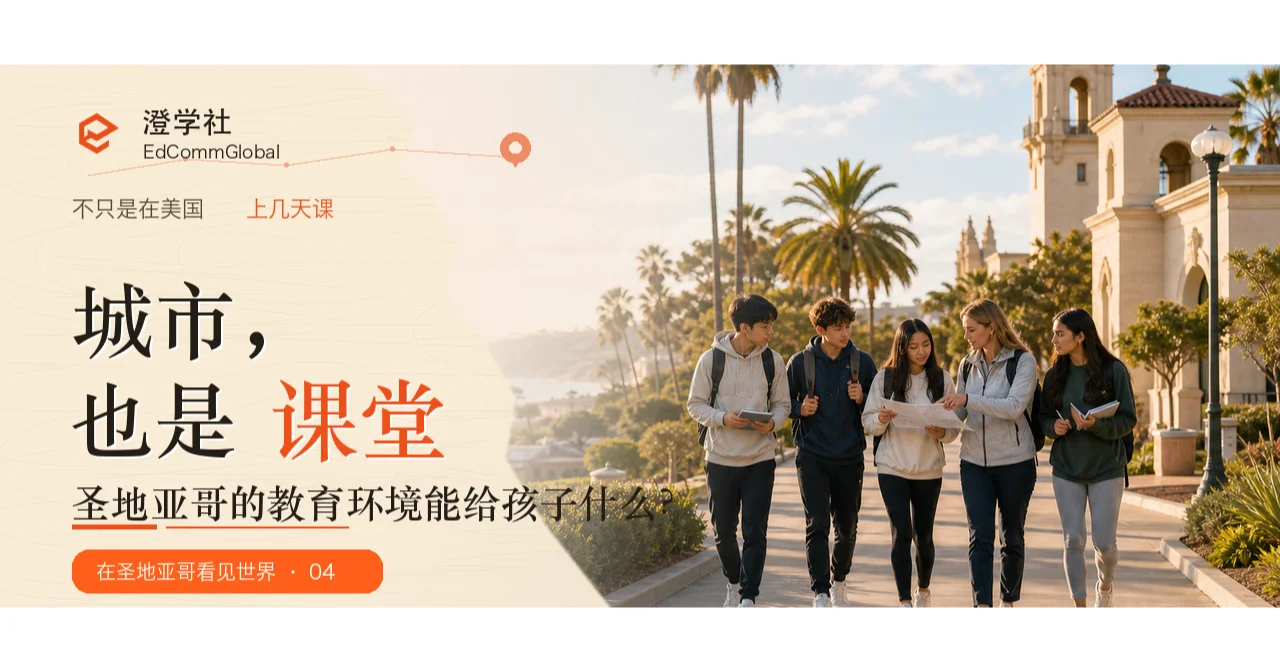
Short answer: If a study tour just moves a Chinese English class into an American classroom, the value is limited. What San Diego offers a child isn't "one school" — it's a full, walkable educational environment: wall-less universities (UCSD, SDSU), American K-12 classrooms with a different atmosphere, Balboa Park's museums and the Fleet Science Center, and public learning settings in parks, along the coast, and in libraries. Stitching those four kinds of scenes together is what "city as classroom" means.
When the conversation turns to study tours, parents' direct questions are usually some version of these:
What English can my child actually learn in a few days of classes?
Isn't flying to America for a few class sessions basically a disguised vacation?
When a child goes to America to 'experience' the education environment — what exactly are they experiencing?
All of these are really asking one thing: what does sending a child across an ocean for a few class sessions actually buy?
Our answer: if a study tour just relocates a Chinese English class into an American classroom, there's no point. But San Diego works as a study tour destination precisely because it lets education break out of the classroom. What a child encounters here is a full educational environment — universities, K-12 schools, museums, parks, libraries, and the public activities happening all over the community.
Many Chinese kids have never encountered these settings. Not because China can't build them — but because Chinese kids are scheduled into a classroom from morning to night, with no opportunity and no habit of stepping into these spaces on their own.
Walking onto a university campus beats ten lectures on "college planning"
UCSD, SDSU, the other San Diego universities — what's special about them is that they have no walls.
A child can walk into the library, through the academic buildings, sit on the lawn watching students eat lunch with laptops in hand. The campus cafe has professors marking papers, undergrads working on group projects, grad students rolling luggage out to fieldwork.
The first reaction from many kids: "Oh — so this is what college is." It's no longer an abstract goal that only appears after the college entrance exam. It's a specific, walkable way of life.
We don't force kids to memorize university rankings on campus — that's a different game. What we care about is whether the child can feel "I could be in a place like this in the future." That feeling does more than ten college-planning lectures.
American K-12 isn't a Chinese classroom with an accent
When a program can arrange short-term observation, workshops, or peer exchange with a local school, that itself is another layer of education.
American K-12 classroom culture is very different from Chinese. Seats are in a circle. Teachers stand and walk around. Questions are open-ended. Answers are shouted out with raised hands. The first time a kid sits in one, they realize: oh — class can work this way.
Many kids tell us afterward, the most shocking part wasn't the English — it was "the realization that a class doesn't need a correct answer." The teacher really does throw out a question and let everyone share their own thinking. No standard answer. No demerits for being "wrong."
This classroom style isn't necessarily right for every Chinese child's growth path. But seeing it once does shift their attitude toward learning going forward.
Museums and science centers: knowledge in open spaces
Balboa Park concentrates more than a dozen museums — art, natural history, space science, children's creativity, and more. The Fleet Science Center is a hands-on science museum for teens, full of interactive exhibits.
These spaces share one quality: knowledge is set out in the open, not locked in a textbook.
Chinese kids' learning experience is mostly knowledge transmitted from the teacher's mouth into the brain, ready for the test. In these spaces, the kid has to walk, look, ask, and discuss with peers themselves. Completely different learning pathway.
When we lead groups, we design tasks: find an answer inside a particular exhibition, give a short on-the-spot English presentation, interview a staff member with one question. These tasks turn "visiting a museum" from a check-in into actual learning.
Parks, coastline, libraries — quietly teaching too
The educational environment isn't just universities and museums. On the lawns at Balboa Park, you'll see a family teaching a kid to ride a bike, an older person reading on a bench, a few teens shooting skateboard videos. Along the La Jolla coast, volunteers often give talks on seal protection. The children's section of the public library hosts free story hours and craft activities.
What kids see in these spaces is a way of life where learning continues without "going to school." Learning isn't just sitting in class. It's observing in public spaces, reading, participating, contributing.
You can't teach this in one session. But a city that lets it show up naturally in public spaces leaves a real, gradual mark on a child.
FAQ
What can a child actually learn in a few days of US study tour classes?
If the tour just relocates a Chinese English class into an American classroom, there's no point. What San Diego offers isn't "one school" — it's a full educational environment: universities (UCSD/SDSU), American K-12 classrooms, Balboa Park's museums, the Fleet Science Center, public libraries, the coastline. Stitched together, those scenes are what "education" actually means.
Is the UC San Diego (UCSD) campus open for visitors?
UCSD has no walls. A child can walk into the library, through the academic buildings, sit on the lawn watching students eat lunch with laptops in hand. The campus cafe has professors marking papers, undergrads working on group projects, grad students rolling luggage out to fieldwork. Letting a child genuinely feel "I could be in a place like this in the future" does more than ten college-planning lectures.
Is Balboa Park a good place for a teen study program?
Very. Balboa Park concentrates more than a dozen museums — art, natural history, space science, children's creativity, and more. The Fleet Science Center is a hands-on science museum for teens. On EdComm tours, leaders design tasks for kids: find an answer inside a particular exhibition, give a short on-the-spot English presentation, interview a staff member with one question. The tasks turn "visiting a museum" from a check-in into actual learning.
How is an American K-12 classroom different from a Chinese one?
American K-12 classroom culture is very different: seats arranged in a circle, the teacher standing and walking around, open-ended questions, answers shouted out with raised hands. Many kids tell us afterward the most shocking part wasn't the English — it was "the realization that a class doesn't need a correct answer." The teacher really does throw out a question, let everyone share, with no standard answer and no demerits for being "wrong."
What does "city as classroom" actually mean?
Four pieces stitched together:
- The university tells the child: you could be in a place like this in the future.
- K-12 tells the child: a classroom can work in another way.
- Museums tell the child: knowledge is something you can go find.
- Public spaces tell the child: learning happens continuously.
These four things can show up in fragments in Chinese cities too — but it's hard to find a setting where a child can walk through all of them concentrated into one or two weeks the way they can in San Diego.
"City as classroom" is a learning pathway, not a slogan
Stitch all of this together, and what San Diego offers kids isn't "one American school." It's a whole walkable city.
The university tells them: this is what your future could look like. K-12 tells them: classrooms can work in another way. Museums tell them: knowledge is something you can go find. Public spaces tell them: learning happens continuously.
These four things can show up in fragments in Chinese cities too. But it's hard to find a setting where a child can walk through all of them concentrated into one or two weeks the way they can in San Diego.
When we bring kids here, that's the pathway we want them to walk. A few English classes are a small part. The real education happens after they step out of the classroom.
Related reading in this series:
Related reading

Why We Chose San Diego as the First Stop for American Study Tours
The first city a child visits shapes their entire impression of America. Here's why we chose San Diego — safety data, city pace, educational resources, and a culture of warmth.
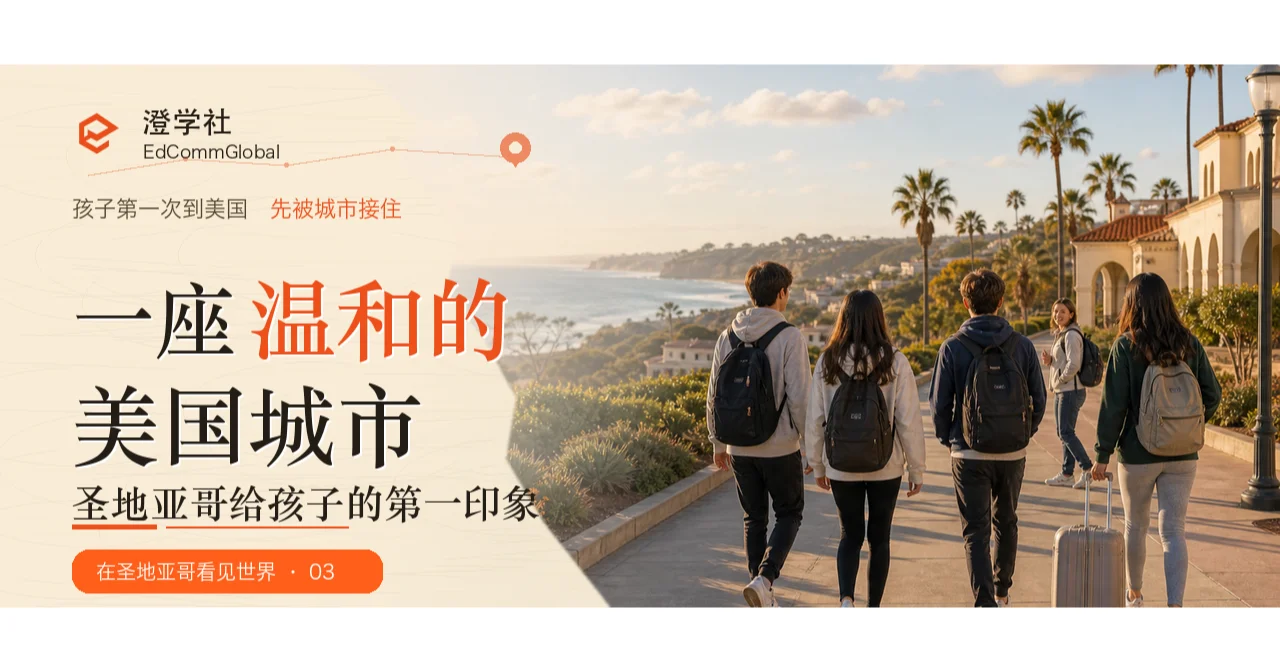
A Gentle American City: San Diego's First Impression for Kids
A child's first impression of America shapes whether they explore confidently or shrink into the group. San Diego consistently gives kids one thing: a gentle landing — sunlight, slow pace, and a city that lets them step forward.
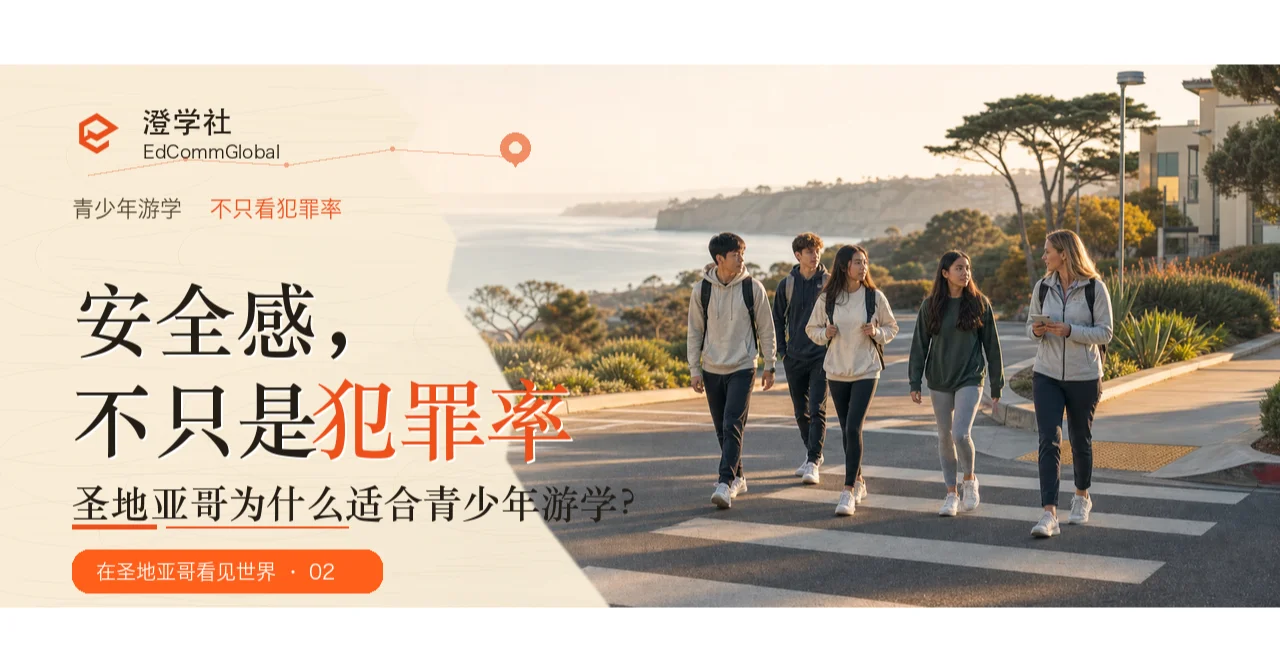
Safety Beyond the Crime Rate: Why San Diego Works for Teen Study Tours
Real safety on a teen study tour isn't just about crime statistics. It depends on five layered factors: city zoning clarity, activity radius control, group leader systems, medical preparedness, and the child's own sense of boundaries.