Will UC Bring Back the SAT? The Real Issue Is STEM Math Readiness
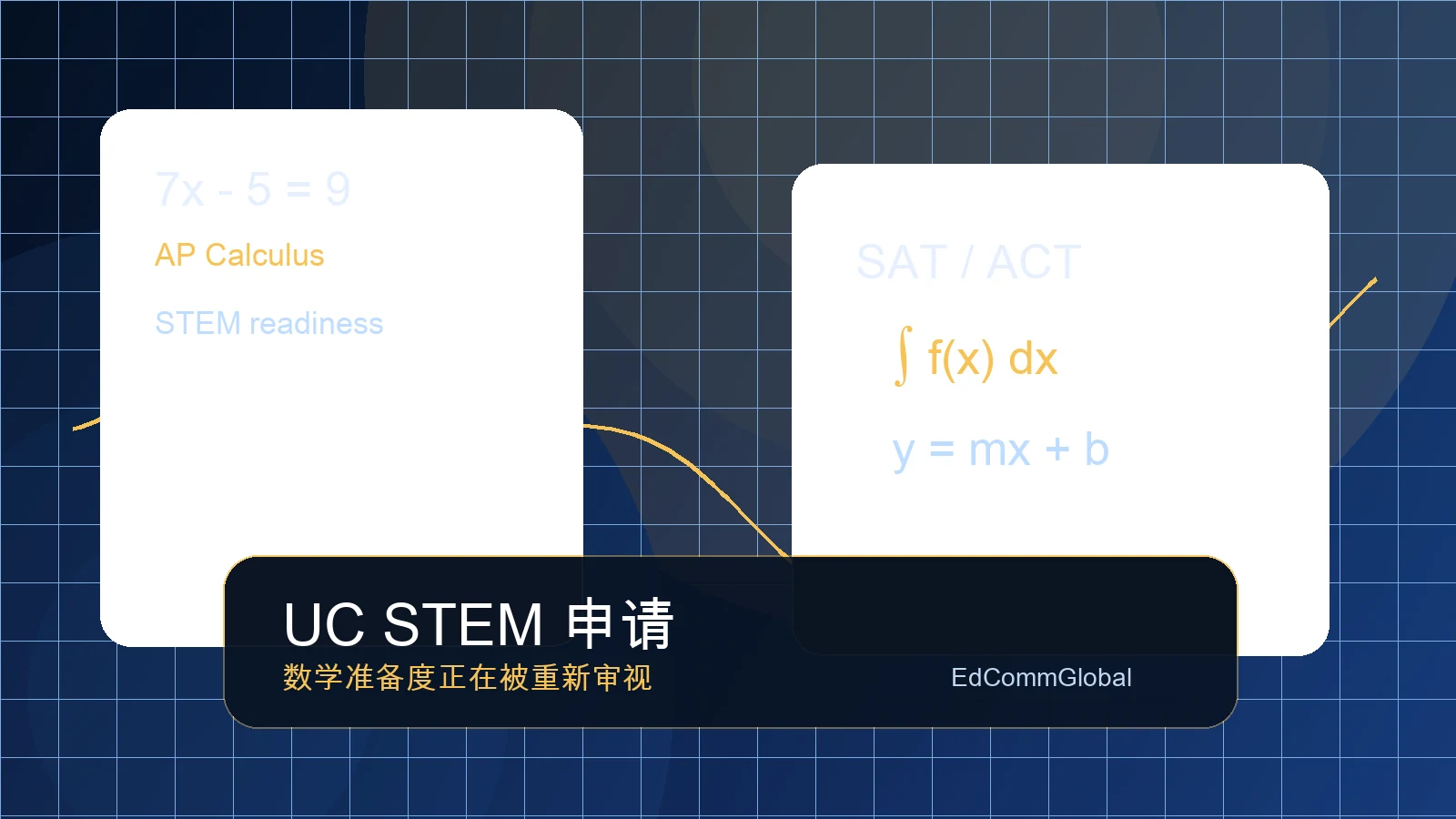
Short answer: The real question is not whether UC will bring the SAT back, but whether a STEM-bound student can clearly prove they are ready for college math — and that proof comes from the math course path, the choice of AP math, and genuine mastery of the content, not from any single score. What families should track now is getting the math path, AP choices, and a testing contingency in order from grades 7–11, so the student has a clear academic through-line no matter how the policy shifts.
Recently the debate over SAT/ACT inside the UC system has flared up again.
According to a June 9 EdSource report, more than 1,400 University of California faculty signed an open letter asking UC to bring back an SAT or ACT requirement for students applying to STEM fields.
Their reasoning isn't simply that "testing is fairer" or "testing is more effective." What really worries these professors is something else:
A portion of the freshmen entering UC are not ready in math.
One detail in the report is hard to look past.
UC Berkeley math professor Zvezdelina Stankova said that during a calculus office hour she met several first-year students. They came to ask calculus questions, but got stuck on a middle-school algebra problem:
7x - 5 = 9, solve for x.
This isn't a competition problem, and it isn't college math.
It's the most basic algebra.
If a student who has already gotten into UC Berkeley visibly struggles with a problem like this, then it's not really surprising that UC is starting to reopen the discussion about admissions screening.
The question isn't only "will the SAT come back."
The deeper question is: can today's application materials still accurately judge whether a student is ready for STEM at UC?
Source note: This article is based on the EdSource report of June 9, 2026, "UC freshmen increasingly are not ready for college math. Some professors want to require the SAT again," and the UC faculty open letter it cites, read alongside 澄学社's observations of US-college course planning for Chinese families. Whether UC adjusts its SAT/ACT policy may change at any time and must ultimately be confirmed against UC's official announcements. This article is planning guidance and a consultant's judgment to help you sort out the path ahead; it is not a promise or guarantee of any admission outcome.
This article focuses on three things: whether UC might reconsider SAT/ACT; why this is tied to STEM math readiness; and how families with students in grades 7–11 should review their math path, AP choices, and testing contingency now.
Don't fixate only on the SAT
When many parents see this news, their first reaction is:
"Is UC going to bring back the SAT again?"
"Does my child need to start preparing for the SAT all over again now?"
"Wasn't it test-blind before? How is it changing again?"
These are fair questions to ask. But if you fixate only on the SAT, it's easy to look at this the wrong way.
UC stopped requiring the SAT/ACT starting in 2020, and later moved further to test-blind — meaning SAT/ACT scores aren't used in admissions at all. There were real reasons behind this policy: standardized tests have long been criticized for favoring well-resourced families and for potentially widening gaps across income, ethnicity, and school resources.
But a few years on, another problem has surfaced.
If you don't use the SAT/ACT, what does a university rely on to judge a student's academic readiness?
GPA?
AP?
High school course rigor?
Teacher recommendations?
School background?
Activity record?
Essays?
All of these materials have value. The problem is that they don't necessarily give a stable answer to one very specific question: can this student handle first-year STEM math in college?
For STEM, that's no small matter.
For Chinese families, the real signal is: proof of math ability is going to matter more
If UC really does reopen SAT/ACT discussion in the future, it won't necessarily simply return to the old admissions model.
What's more likely is this: STEM applications will increasingly emphasize proof of "math readiness."
That proof isn't necessarily just an SAT math score. It can come from many places:
- The high school math path;
- Whether Precalculus / Calculus is completed;
- AP Calculus AB or BC;
- Whether grade-11 math grades are stable;
- Whether the course rigor is convincing within the student's own school context;
- Whether the intended major and course choices line up;
- If the SAT/ACT is allowed or required again, whether the student can produce a competitive score.
This matters a lot for Chinese families.
Over the past few years, quite a few families formed a fairly simple understanding of UC applications:
Keep the GPA high, take a lot of AP, make the activities look good, write the UC essays well. The SAT isn't being looked at, so set it aside.
You can't call this thinking wrong, but it's no longer enough.
Especially for students targeting CS, engineering, data science, physics, math, biostatistics, or economics, parents shouldn't only ask:
"Does UC still look at the SAT or not?"
The better questions are:
"If UC doesn't look at the SAT, what materials does my child have left to prove math ability?"
"If UC starts looking at the SAT again, is it already too late for us to prepare?"
These two questions matter more than "should we sign up for an SAT class right away."
Why STEM is the most sensitive to this
STEM majors have very little room for error.
A student can have a solid essay, rich activities, and an impressive record, but if the math foundation is shaky, they'll hit a wall soon after starting college.
Especially in fields like engineering, CS, math, physics, and data science, the first-year courses won't slowly wait for a student to adjust. Many courses are filtering people from the very start.
That's also why this open letter comes mainly from STEM professors.
What they worry about isn't that students "aren't smart enough."
What they worry about is that some students enter their major before they're ready, and the university failed to identify it before admission.
For the student, the consequences are very real:
A low first-semester GPA; being forced to switch majors; setting out for STEM and later getting pushed off it; research, internships, transfers, and graduate-school paths all affected.
So on the surface this debate is about the SAT, but underneath, UC is asking itself: does the admissions system actually have the ability to judge a student's academic readiness in advance?
What families with grade 7–11 students should do now
Parents don't need to panic, but they do need to take another look at their child's coursework and application path.
Especially in grades 7–11: if the child is aiming for UC STEM, there's still room to adjust now. Any later, and it becomes damage control.
1. Look at the math path first, not the test
Many parents, the moment they hear the SAT might come back, immediately think about drilling practice problems.
But for STEM applications, the math path is more fundamental than the test.
Parents need to look at these questions first:
Where is the child in math right now?
Can they reach Calculus naturally across grades 9–12?
If the goal is CS or engineering, is there a chance to take on AP Calculus BC?
If the school's courses aren't enough, do they need to fill the gap through community college, an online course, or a summer course?
Are the current math grades genuinely solid, or are they being propped up by tutoring and short-term cramming?
If the math path itself isn't strong enough, a high SAT math score can only fill part of the gap. It can't replace four years of cumulative coursework.
2. Don't throw out the SAT/ACT entirely
Over the past few years, because UC went test-blind, some families gave up on the SAT/ACT completely.
That carries risk.
This isn't to say every child must restart the SAT now, nor that the SAT will once again decide everything. But if a child is aiming for UC STEM, engineering or CS at private universities, or may consider scholarships, honors programs, or transfer paths in the future, standardized testing is still worth keeping as a contingency.
More practically: if the policy suddenly changes, will the child have time to catch up?
A diagnostic around grade 10 is reasonable.
Not to start chasing a score immediately, but to know where the child stands.
If the foundation is solid, they can focus on prep later.
If the gap is large, parents should at least know ahead of time, rather than discovering in the second half of grade 11 that it's too late.
3. Don't turn AP into a numbers game
Many families tend to turn AP into "the more the better."
But STEM applications aren't viewed that way.
What admissions officers really care about isn't just how many AP courses a student took, but whether the course combination has logic to it.
If a child is aiming for an engineering major but the math path is mediocre and physics is weak, stacking up numbers with a few relatively easy-scoring AP courses helps only so much.
A better approach is to let the courses form a clear through-line:
Math steadily climbs; science courses relate to the intended major; AP difficulty progresses; the GPA isn't broken by hard courses; and there's a relationship between activities and the intended major that holds up to explanation.
This is worth more than simply adding two more AP courses.
4. Don't wait until grade 11 to find that the major direction doesn't match
What STEM planning fears most isn't preparing for the SAT one year late.
What it fears most is discovering in grade 11 that:
Math moved too slowly; the AP courses were ordered wrong; the GPA has already been dragged down by a few courses; the activities have nothing to do with the intended major; the child actually isn't suited to the direction originally set; and there's no clear academic thread to tell when applying to UC.
These problems can't be fixed at the end with the essay.
The essay can help admissions officers understand the student, but it can't manufacture academic readiness out of thin air.
How we see this
We don't advise parents to simply read this news as:
"UC is bringing back the SAT, so hurry up and sign up for a class."
That judgment is too hasty, and too coarse.
More precisely, whether UC reinstates the SAT/ACT still has to go through institutional discussion; one open letter won't change all the rules overnight.
But one thing is already clear: STEM math readiness has become a core topic again.
The effect of this on family planning may matter more than "exactly which year the SAT comes back."
In the coming years, students targeting UC STEM need to answer three questions in advance:
- Does my math path support my intended major?
- If there's no SAT/ACT, what do I use to prove academic readiness?
- If the SAT/ACT is used again, do I still have time to prepare a competitive score?
The earlier these three questions are asked, the easier they are to adjust.
The later they're asked, the more easily they turn into damage control.
Three things parents can do now
First, pull out and review the child's grade 9–12 course plan.
Don't only look at next semester — look at the full four years. Focus on math, science, AP, and GPA risk.
Second, run a baseline SAT/ACT diagnostic.
Not to start chasing a score right away, but to gauge the child's current foundation. If the policy changes, the family at least has a contingency.
Third, look at the major direction and course choices together.
CS, engineering, data science, biology, economics, and business don't have the same requirements for math and course combinations. Don't apply one template to every major.
FAQ
Has UC already brought back the SAT/ACT?
No. This article discusses the UC faculty open letter and the debate inside UC over STEM math readiness. Whether the SAT/ACT is reinstated still depends on UC's subsequent official policy.
If my child is aiming for UC STEM, do they need to start drilling the SAT right away?
Not necessarily. The steadier approach is to run a baseline diagnostic first, then look at the child's grade level, math path, and target schools. If the child is already in grade 10 or 11 and may apply to schools that require testing, keeping an SAT/ACT contingency is safer.
If UC stays test-blind, does math readiness still matter?
Yes. Even without the SAT/ACT, universities will still use course rigor, grade trends, AP Calculus, school background, and major fit to understand whether a student is ready for STEM.
Is AP Calculus BC always better than AB?
Not every student has to push for BC. What matters is whether the course path matches the intended major, whether grades are stable, and whether the student genuinely masters the content. Forcing BC and dragging down the GPA isn't necessarily worth it.
One last reminder for parents
If a child is aiming for UC, especially UC's STEM, CS, engineering, data science, economics, or biology directions, the question now shouldn't only be "should we take the SAT."
What matters more is running a full review of the admissions path:
Whether the math path is reasonable; whether the AP choices match; where the GPA risk is; whether the SAT/ACT should be kept as a contingency; whether the major direction needs adjusting; and whether the pacing across grades 9–12 is still in time.
Policy will change, and the discussions inside the university will go back and forth.
But one thing won't change: a student who is genuinely ready always has more options.
Related reading:
- How Returning to the US for High School Boosts Your Child's College Chances
- Is US High School Worth It? A Decision Framework for Families
- The US-Born Family Roadmap for Grades 6–10: What to Prepare and Decide Each Year
- Admissions Officers: AP Is a Brand; Rigor Is the Real Question
How 澄学社 can help
If you're not sure whether your child's current coursework, math path, and intended major line up, you can do a UC / STEM-focused admissions planning diagnostic with 澄学社.
We focus on:
- Whether the current math path is sufficient;
- Whether AP and honors courses are arranged sensibly;
- Whether the GPA risk is manageable;
- Whether the SAT/ACT should be kept as a contingency;
- Whether the intended major needs adjusting;
- How to lay out the application pacing over the next 1–3 years.
Rather than waiting until grade 11 for damage control, it's better to get a clear view of the path now.
References
- EdSource, 2026-06-09, "UC freshmen increasingly are not ready for college math. Some professors want to require the SAT again"
- UC faculty open letter on STEM admissions and mathematical readiness, cited by EdSource
- UC 2020-2021 SAT/ACT policy changes, cited by EdSource
Related reading

Cornell Admissions Officer Marina Fried: We Never Reject a Student Over One Score
Cornell admissions officer Marina Fried explains why scores and AP course selections aren't the deciding factor — admissions teams look for whole, alive students. The opening piece of our Admissions Officers Interview series.
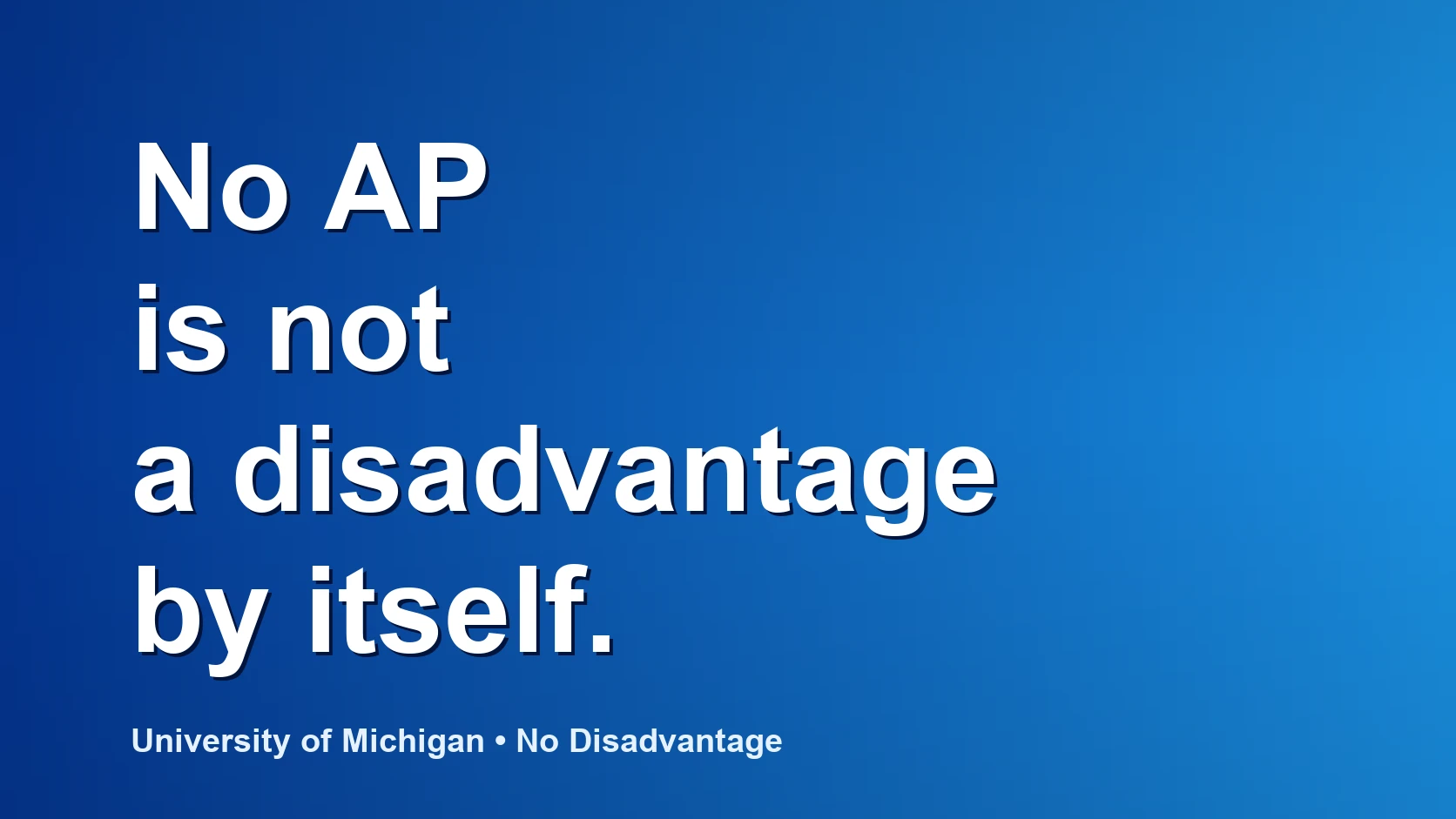
Michigan Admissions: No AP Is Not a Disadvantage by Itself
In video 8, Michigan admissions explains that no AP is not a disadvantage by itself; colleges evaluate subject preparation, rigor, sequencing, and context.

Admissions Officers on Future Skills: Do Not Teach Only to the Test
Video 6 emphasizes future-ready skills: close reading, writing, debate, critical thinking, and flexible learning across disciplines.