Public vs Private School in San Diego When a Parent Cannot Stay Full Time
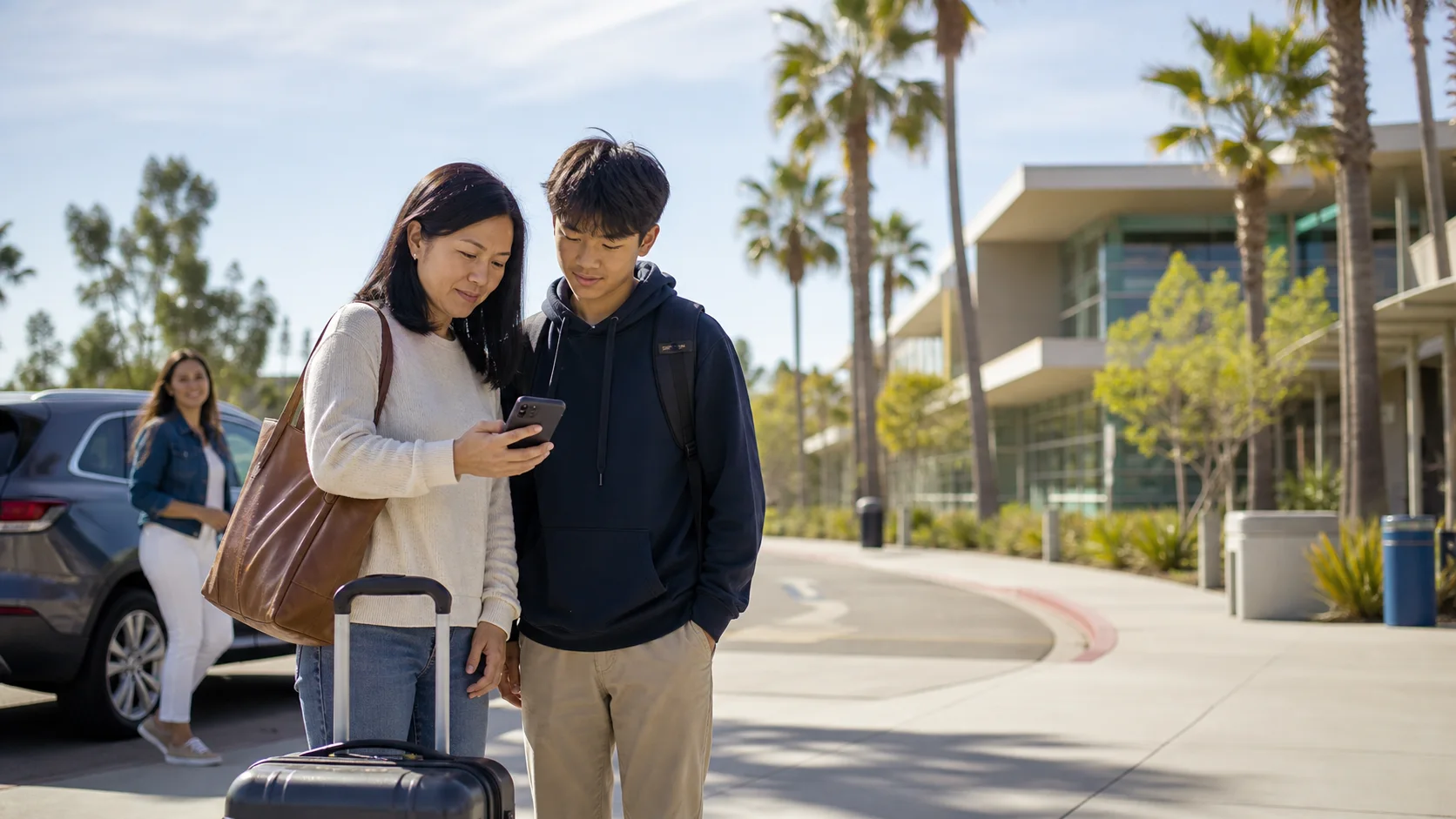
Short answer: If a parent cannot stay in San Diego full time, the public-vs-private decision is not mainly about free public school versus private tuition. It is about whether the family can maintain valid residency, daily supervision, transportation, school communication, and course support. Public school may work with a real local household plan; private school may be clearer administratively but still requires local adult support.
Many families start with this question: "Our child is a U.S. citizen. If we return to San Diego for school, is public school the most practical choice?"
It is a reasonable question, but if parents cannot stay in the United States full time, it misses the harder layer. Where does the child live after school? Who can appear when the school needs a parent signature? Who answers school calls? Who handles illness, discipline, course placement, activities, breaks, and transportation?
This article does not repeat the broader public vs private school choice framework. It focuses on a specific family situation: parents cannot stay in San Diego full time, but the child still needs a stable school path.
Who this is / is not for
This is for families where:
- the child has U.S. citizenship or a valid school path and plans to study in San Diego;
- one parent can only stay in the U.S. part time;
- both parents mainly work in China and are considering relatives, homestay, or professional support;
- the family is comparing public districts, private schools, housing, guardianship, and annual budget;
- the student is approaching grades 6-10, when a weak school transition can affect course placement, GPA, and college-prep timing.
This is not for families that:
- already have a parent living in San Diego full time and able to manage school matters;
- only want a ranking comparison without discussing daily supervision and documents;
- need legal, immigration, or tax advice. Those questions should be verified with the school, district, attorney, accountant, or other qualified professional.
Reframe the question: not public vs private, but who handles the child's daily life
When a parent can live in San Diego full time, the public-vs-private decision usually centers on district, curriculum, class size, college counseling, social environment, and budget.
When a parent cannot stay full time, the order of decisions changes:
- Does the child have a real, stable, explainable living arrangement?
- Will the school or district accept the enrollment documents?
- Is there a local adult who can handle school, medical, and emergency situations?
- Who manages transportation, activities, school breaks, and illness?
- How much help does the child need with English, writing, course placement, and social transition?
- Can the family afford the total cost, including tuition, housing, guardianship, transportation, and academic support?
If these questions are unanswered, "free public school" may only look low-cost on paper. If these questions are solved, public school may be a valid path.
Decision table
| Decision factor | If considering public school | If considering private school | Parent must verify |
|---|---|---|---|
| Enrollment basis | Districts usually review real residence, address documents, and caregiver/guardian paperwork | Schools review application, interview, grades, recommendations, and available space | District enrollment page, school admissions requirements, current written response |
| Living arrangement | The address should not be only a borrowed or temporary mailing address; the child's actual residence must make sense | The school may not provide boarding; some schools allow family-arranged homestay | Lease, bills, caregiver documents, whether the school accepts the arrangement |
| Local adult | The school needs someone reachable, local, and able to respond to emergencies | Private schools also require local contacts, pickup authorization, medical authorization, and emergency contacts | Guardianship documents, medical authorization, pickup authorization, school record access |
| Transportation and activities | Public school activities often depend on family transportation; distance matters | Private school activities, evening events, and weekend commitments also need transport planning | Daily commute, activity schedule, homestay transportation boundaries |
| School communication | Larger public schools require parents to actively track email, portals, and counselor communication | Private schools may communicate more often, but they do not automatically solve every issue | Who reads emails, books meetings, speaks with teachers, and handles bilingual communication |
| Course support | Public schools can offer broad course options, but families must advocate and plan actively | Private schools may have a clearer advisor structure, depending on the school | Course path, ESL/writing support, GPA risk, graduation requirements |
| Total budget | Low or no tuition does not mean low total cost | Tuition is visible, but housing, guardianship, transportation, and break care are separate | Use the San Diego K-12 annual budget guide as the total-cost framework |
Recommendations by scenario
Scenario 1: A parent can live in San Diego for the full school year
If at least one parent can live in San Diego for the school year and manage school email, conferences, transportation, illness, and course communication, public school deserves serious evaluation.
The key questions are not only about tuition:
- Which school and district match the family's actual residence?
- Does the district have transfer, choice, or boundary rules?
- Can the child handle English writing, class discussion, and social adjustment?
- Can the parent actively work with counselors, teachers, and school systems?
- If the child is entering high school, does the 9-12 course path make sense?
If the family can handle this work, public school may offer strong course breadth, community integration, and budget control. Start with the San Diego school district structure, then evaluate the specific address and student profile. For SDUHSD schools such as Canyon Crest Academy and Torrey Pines High School, the practical question is not ranking alone; it is whether address rules, choice mechanisms, course pace, and family support all fit.
Scenario 2: A parent can only rotate between China and San Diego
This is the situation families often underestimate.
Parents may believe that visiting every few months is enough, but school issues do not follow the parent's travel schedule. A child may face course conflicts, grade drops, social issues, medical appointments, activity transportation, or teacher meetings while the parent is abroad.
This type of family does not automatically need private school, but three things must be covered:
- a school-accepted local adult whom the child also trusts;
- a housing and transportation plan that covers weekdays, evenings, weekends, and breaks;
- someone who continuously tracks email, grades, learning portals, and teacher feedback.
If a reliable relative provides this support, a public path may be realistic. If the family mainly depends on homestay and professional support, a private school may sometimes create a clearer communication structure, but the school fit and cost must be evaluated again.
Scenario 3: Parents cannot stay in the U.S., and the child needs homestay and guardianship
If parents mainly live in China and the child needs homestay, a guardian, and daily coordination in San Diego, the question "Can we use public school?" needs careful verification.
Public districts usually care about actual residence, caregiving relationship, address documents, and district rules. The answer can vary by district, year, and family documents. Parents should not assume that U.S. citizenship means the child can automatically attend any school from any address.
Private school is not an automatic solution either. Most private schools are not boarding schools. Families still need to ask whether the school accepts local homestay, whether a designated guardian is required, and whether it has policies for students whose parents are not local.
For this situation, the family should first:
- confirm the child's status, grade, English level, and target school range;
- evaluate whether homestay and housing support is needed;
- review the guardianship guide for U.S.-born children returning to school;
- compare public, private, homestay, guardianship, and annual budget in one table.
Signs public school may be the better first option
Public school deserves priority when several of these are true:
- A parent or trusted relative can live in San Diego consistently;
- the address, caregiving relationship, and enrollment documents are clear;
- the child has strong enough English reading, writing, listening, and speaking skills;
- the parent is willing to actively research courses, activities, and college-prep resources;
- the family values community integration, course breadth, and budget control;
- the child is independent and does not need frequent adult prompting.
This does not mean public school is a weaker option. For the right student, some San Diego public high schools offer strong courses and peer environments. The condition is that the family can manage residence, daily care, and school communication.
Signs private school may be the better first option
Private school deserves priority when several of these are true:
- parents cannot stay full time and need a clearer communication structure among school, homestay, and local support;
- the child is transitioning from the Chinese system and needs a softer landing in English writing, classroom participation, or social life;
- the family wants advisor, counselor, or college counseling involvement earlier;
- the child is unlikely to navigate a large public school independently;
- the family budget can cover tuition, housing, guardianship, transportation, insurance, and school-break care;
- parents are willing to pay for more visibility and communication density.
Private school is still not the default answer. For a San Diego day school such as Cathedral Catholic High School, families still need to verify selectivity, space, English and academic expectations, and whether the school accepts the family's homestay or guardianship arrangement.
Questions to ask before paying a housing deposit, school deposit, or homestay fee
Before making a hard-to-reverse commitment, write down and verify these questions:
- Where will the child actually live? Does this match school or district requirements?
- Who is the local adult? Can that person sign school, medical, pickup, and emergency documents?
- Has the school or district confirmed in writing that these documents are acceptable?
- If parents are outside the U.S., who checks school email, grades, and learning portals every day?
- Who appears when the child is sick, late, called in by a teacher, or stuck in a course conflict?
- Does the homestay provide only housing, or also transportation, daily supervision, and school communication?
- If the homestay changes, will school enrollment, guardianship, or transportation be affected?
- Does the total budget include break housing, insurance, activities, tests, transportation, and short-term support?
- Does the child accept this arrangement and know whom to contact when something goes wrong?
- If the first year does not work, is there a transfer, public/private switch, or course-adjustment plan?
These questions come before ranking comparisons. For families that cannot stay full time, a strong daily system is what allows the school choice to work.
How EdCommGlobal usually evaluates this decision
We usually do not begin by asking, "Do you want public or private school?" We first map the family's operating model:
- how long each parent can actually stay in San Diego;
- the child's status, grade, English level, and academic goals;
- available address, relatives, homestay options, and budget boundary;
- target schools' enrollment or admissions requirements;
- who handles guardianship, housing, transportation, breaks, and school communication;
- whether grades 9-12 courses, GPA, activities, and college-prep planning can stay continuous.
Then we evaluate whether public school, private school, or a phased plan makes more sense. We do not promise admission to any specific school, and we do not present one route as the only correct answer. The goal is to make the family's real constraints visible before the child lands in San Diego.
If your family is comparing public school, private school, homestay, and guardianship, you can contact us for a school-fit review and put grade, target schools, parent availability, and budget into one decision table.
Source and data verification notes
| Topic | Sources to verify | How this article uses the information |
|---|---|---|
| Public school enrollment and residency rules | District enrollment pages, school registrar, California Department of Education materials | District document requirements vary; this article provides a planning framework only. |
| Private school admissions, housing, and local-contact requirements | School admissions office, family handbook, post-admission documents | Private school policies differ by school and must be confirmed in writing. |
| Guardianship, medical authorization, and school record authorization | School forms, California official resources, attorney or qualified professional | This is not legal advice; important documents need professional confirmation. |
| Housing, homestay, and transportation | Homestay agreement, service boundaries, school transportation expectations | Homestay is not the same as legal guardianship; service boundaries must be explicit. |
| EdCommGlobal judgment | Family interviews, school visits, cross-checking public information, service experience | This is educational planning judgment to help families ask better questions, not an official conclusion. |
FAQ
Can a child attend a San Diego public school if parents are not in the U.S.?
There is no simple yes-or-no answer. Public schools usually review where the child actually lives, who provides care, what address documents exist, and what the district's enrollment rules require. U.S. citizenship alone does not mean the child can attend any district from any address. Parents should verify with the specific district or school.
If a parent can only stay short term, should the family choose public or private school?
Start with who handles daily responsibility when the parent is away. If a trusted relative can provide stable care and manage school matters, public school may be evaluated. If the family mainly relies on homestay and professional support, private school may create a clearer communication chain, but school policy and total cost still need verification.
Do private schools provide homestay and guardianship?
Not necessarily. Many private schools are not boarding schools and do not directly provide homestay or legal guardianship. They may require families to arrange a local contact, transportation, medical authorization, and housing. Ask the school what arrangements it accepts before applying.
Is public school always cheaper for a U.S.-born child?
Not always. Public school may have low or no tuition, but housing, guardianship, transportation, insurance, school-break care, and academic support can still make the annual cost substantial. Compare total annual cost, not tuition alone.
When should a family ask for a school-fit review?
If parents cannot stay for the full school year, the student is in grades 6-10, the family is comparing public and private options, or address and homestay are not settled, a school-fit review should happen before choosing a school name. The first task is to test whether the daily life system and academic path can stay continuous.
Related reading
- Public or Private? How US-born Children Should Choose When Returning to US Schools
- Legal Guardianship for US-Born Children Studying in America: What Parents Must Know
- San Diego homestay and housing support
- San Diego K-12 annual budget guide
- San Diego school districts and public school structure
- Cathedral Catholic High School profile
- Canyon Crest Academy profile
- Torrey Pines High School profile
Related reading
San Diego Grade 8: SDUHSD Public vs Private in 7 Checks
Compare SDUHSD public and private-school paths across seven checks: enrollment, school choice, learning pace, English, courses, family support, and total cost.

CCA or Torrey Pines? 4 Address and School Choice Risks
Before renting or buying for CCA or Torrey Pines, verify four risks: district residence, boundary assignment, School Choice timing, and residency proof.

92130 Elementary Enrollment: Address Checks
Planning 92130 elementary enrollment from China? Check DMUSD or SBSD address rules, age, records, capacity, lease costs, pickup, and later school stages.