UCSD Class of 2026: 4 Skills to Build in High School

Short answer: UCSD's Class of 2026 commencement should not be read as "every high school student needs a research project." The broader planning signal is that colleges value students who ask meaningful questions, adapt when the path changes, and turn curiosity into evidence through coursework, writing, projects, community engagement, and reflection.
UC San Diego Today published its Class of 2026 commencement story on June 16, 2026. The piece returns to a few themes: curiosity, discovery, resilience, community, and the ability to move ideas into action. Chancellor Pradeep K. Khosla, UCSD alumnus Fred Ramsdell, and student speakers all framed graduation as the beginning of continued inquiry rather than the end of a checklist.
This article is not an interpretation of UCSD admissions policy. It does not mean UCSD prefers one specific activity. For families, the better use is planning: if universities ultimately hope students can ask, explore, adjust, and contribute, how should grades 9-12 coursework, activities, writing, and projects be built before the application year?
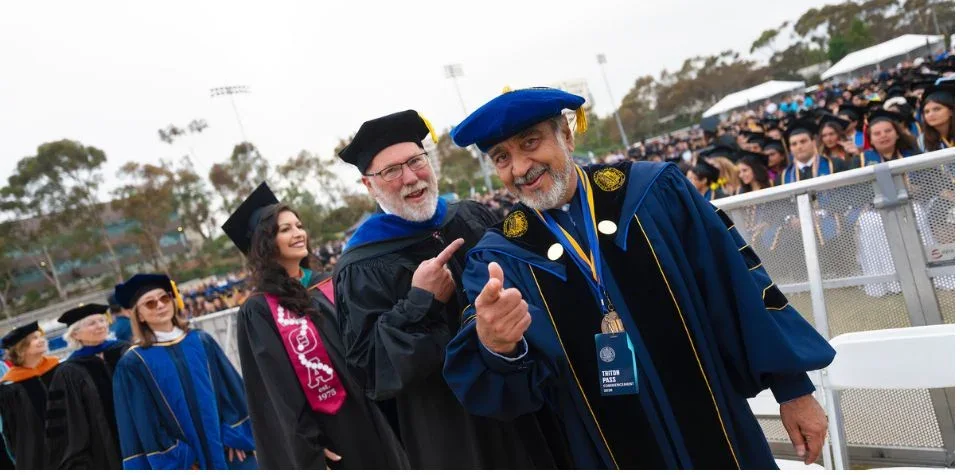
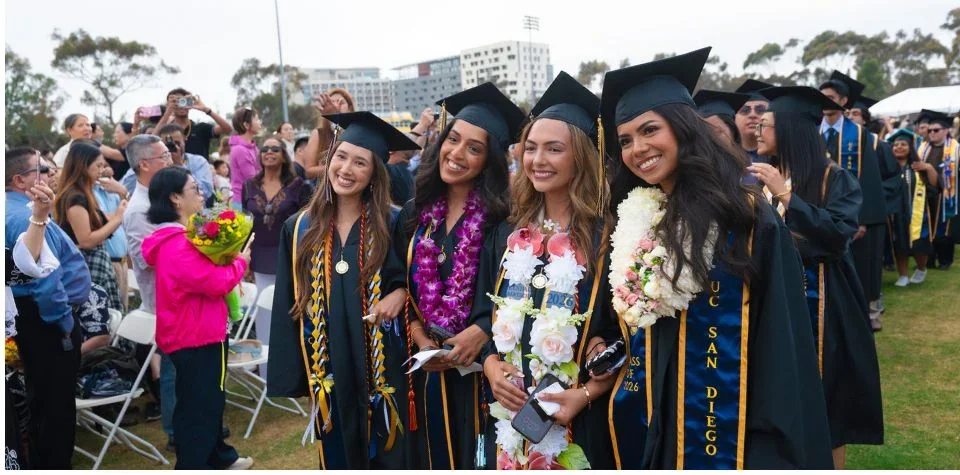
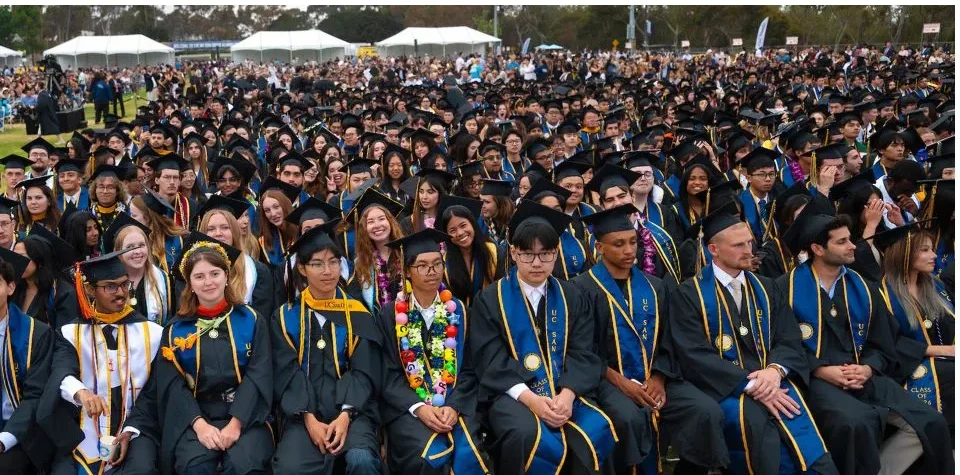
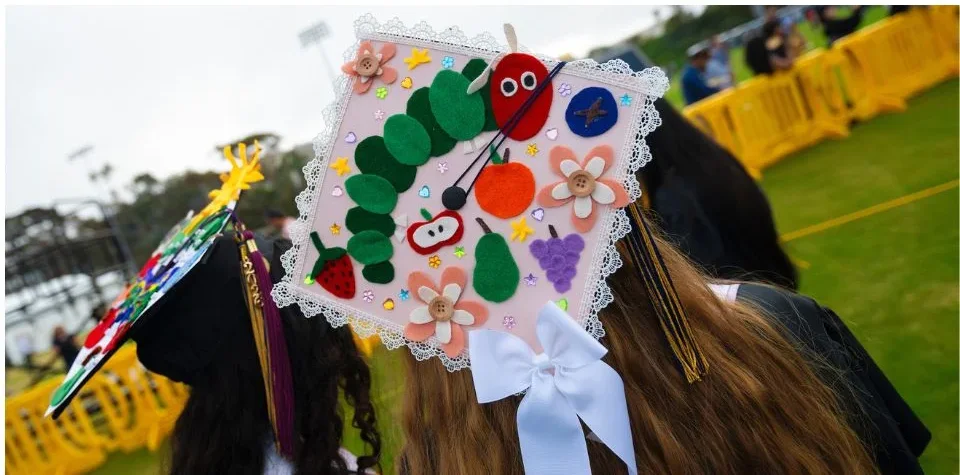
Image source: UC San Diego Today, "The Class of 2026 Embraces a Future of Discovery." The four commencement images cited in this article are cropped from the same collage in the UCSD source article. Photo credit: Erik Jepsen, UC San Diego.
Who this is / is not for
This article is for families whose student:
- plans to attend high school in the U.S. or apply to U.S. colleges;
- is studying in a San Diego public or private high school and needs a four-year plan;
- is a US-born Chinese student returning to the U.S. and wondering whether GPA and APs are enough;
- has early interests in STEM, medicine, engineering, data, humanities, music, or social issues, but no clear direction yet;
- needs to connect interests, activities, writing, and course choices into a coherent growth story.
This article is not for families who want:
- UCSD's official admissions preferences, acceptance rate, or internal scoring rules;
- a checklist that promises admission to UCSD;
- a formula built from a commencement speech. College applications still depend on coursework, grades, context, essays, activities, and fit.
Decision table
| Signal from the UCSD story | High school planning implication | What parents can do | Do not over-read it as |
|---|---|---|---|
| The commencement story emphasizes curiosity and discovery | Students need questions worth pursuing, not only completed tasks | Starting in grade 9, track topics the student genuinely keeps asking about | "Every student must do lab research" |
| Fred Ramsdell's story highlights a non-linear path | Direction can change, but changes need reasons and action | Each semester, review courses, activities, reading, and projects together | "Planning does not matter" |
| Student speakers connect growth with identity, community, and better questions | Colleges see how students learn inside real environments | Help the student turn community experience into observation, questions, and action | "Just add more service hours" |
| Multiple UCSD schools and divisions appear in the broader commencement context | Real university learning is often interdisciplinary | Connect math, writing, data, art, and social issues around one question | "Interdisciplinary packaging is required" |
| The story mentions support systems, family, and mentors | Mature students ask for help and use resources | Train the student to use teachers, office hours, counselors, and peer feedback | "Parents should manage every conversation" |
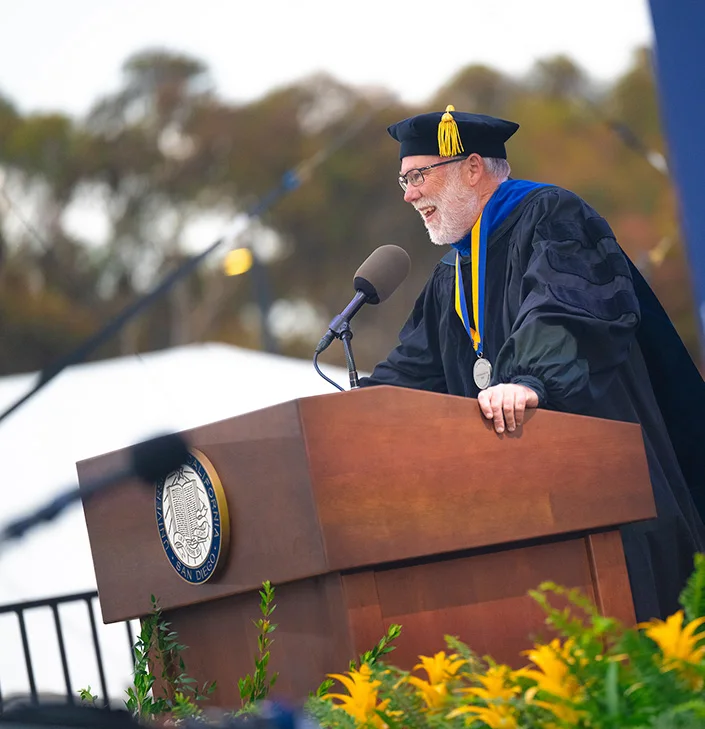
Image source: UC San Diego Today, "The Class of 2026 Embraces a Future of Discovery." Original UCSD caption: Keynote Speaker Fred Ramsdell '83.
What "discovery" means before college
Many parents hear "discovery" and immediately think of research, competitions, or summer programs. Those can be useful formats, but they are not the core.
High school students need four practical abilities.
First, turn interest into a question.
"I like biology" is too broad. A better starting point is: "Why do some pre-med students struggle when chemistry and writing-heavy courses hit at the same time?" or "What language barriers do older adults face when they use health information?" A specific question makes reading, interviews, courses, and projects easier to connect.
Second, support claims with evidence.
U.S. high school and college work asks students to explain claims, evidence, and reasoning in English, history, science reports, research projects, and essays. For US-born Chinese students returning from a Chinese-language system, this is often the real academic bottleneck. Families can also read the English writing readiness guide.
Third, experience trial and revision.
A project that stalls, a course that is harder than expected, or an activity that changes direction is not automatically a failure. The question is whether the student can explain the original plan, what did not work, what changed, and what comes next. Colleges do not need every story to be perfect. They need to see how a student handles uncertainty.
Fourth, place personal interest in a real environment.
In the UCSD story, discovery is not only a laboratory word. It is also connected to community, family, identity, and courage. For high school students, a strong project does not have to be large. It should be real: real people, real problems, real materials, and a process the student can explain.
Recommendations by grade
Grades 7-8: observe what the student keeps asking about
This is not the stage to lock in a major. It is the stage to watch where the student naturally reads more, asks more, and does more than required.
Parents can:
- ask the student each month to explain one nonfiction topic with one claim and two pieces of evidence;
- notice whether the student is strongest with data, writing, hands-on work, presentation, organization, or care for others;
- if grade 8 to 9 is approaching, learn how high school courses, GPA, and writing expectations work.
Families comparing public and private high school should read the grade 8 SDUHSD public vs private decision guide. The question is not which school type is universally stronger. It is where the student can build a stable academic rhythm.
Grades 9-10: build course depth and expression together
Grades 9-10 are the foundation. Parents often focus on Honors, AP, and GPA. Those matter, but the later application story also depends on whether the student can turn coursework into clearer questions.
Useful planning moves include:
- if math and science are strong, do not ignore English writing and history reading;
- if the student leans humanities or social science, build basic data, research-method, and source-checking habits;
- if the student leans art, music, or design, ask the student to explain the problem, materials, and audience behind the work;
- each semester, save one writing sample, project, or presentation that shows growth.
This connects with our earlier piece on why future skills are not the same as teaching to the test. Course rigor matters, but if the student only completes assignments and never builds a line of inquiry, the application will be harder to explain.
Grade 11: turn the interest line into verifiable work
Grade 11 is usually too late to invent a direction from nothing. A more realistic goal is to organize the clues from grades 9-10 and choose one or two lines to deepen.
Evidence does not have to be a published paper. It can be:
- a research-style essay with sources and a clear method;
- an observation report and improvement plan from a long-term service project;
- a design, music, data, or engineering portfolio with user or audience feedback;
- an independent study that grew out of a school course;
- any body of work that shows questioning, trial, revision, and communication.
If the student attends CCA, Torrey Pines, Canyon Crest Academy, or another highly competitive high school, parents should be careful about copying what other students do. Start with the CCA four-year planning guide. The point is not to replicate a path. It is to judge course load, academic pressure, and theme continuity.
Grade 12: essays explain evidence; they do not replace it
By grade 12, the hardest applications are often not the ones with too few activities. They are the ones where each activity looks isolated.
A stronger application story can answer:
- What question has kept attracting this student?
- How did courses and activities test that interest?
- What changed when the student met difficulty?
- How did the student use school, community, teacher, and peer resources?
- How is the student likely to learn and contribute in college?
The useful planning lesson from UCSD's commencement story is that college should open students toward larger questions. High school should not become an over-managed template.
Three common parent mistakes
Mistake 1: reducing discovery to "a research project"
Research can be a strong path, but it is not the only path and not every project is meaningful. A student who only attaches their name to a project but cannot explain the question, method, failure, and revision may have weaker evidence than a smaller school or community project they truly owned.
Mistake 2: chasing rigor without checking expression
AP, Honors, competitions, and GPA matter. But college applications are not a sum of labels. Students need to explain why they chose certain courses, what they learned, and how the work led to more specific questions. For students with weak academic English, expression may be more urgent than one additional advanced course.
Mistake 3: parents designing the whole path too tightly
Some families do not lack planning. They over-plan. If the student never truly asks, chooses, struggles, or revises, the final essay becomes a list of activities. Parents can provide resources and boundaries, but the evidence of growth has to come from the student.
How EdCommGlobal helps families make this practical
We usually do not begin by asking, "What major does the student want?" A better planning review starts with the student's current evidence:
- courses, grades, reading, and writing samples;
- whether the main issue is course pressure, English expression, activity depth, or direction;
- a grade 9-12 map for courses, writing, projects, activities, summer, and school communication;
- an evidence folder that can be reviewed over time instead of reconstructed during application season;
- regular checks on whether the direction still feels real and whether it needs adjustment.
If your student is still preparing for high school, start with University Preparation. If the family is already making course choices, project decisions, or college-essay direction decisions, contact EdCommGlobal for a school-fit and college-planning review.
Source and data verification notes
| Information type | Source | How this article uses it |
|---|---|---|
| UCSD Class of 2026 commencement story | UC San Diego Today: The Class of 2026 Embraces a Future of Discovery, published June 16, 2026 and last verified September 2, 2026 | Used to observe UCSD's public framing of graduate growth, discovery, and community. This article does not treat it as UCSD admissions policy. |
| UCSD image references | Same UC San Diego Today source article; the four commencement images are cropped from the source collage credited to Erik Jepsen, UC San Diego; the Fred Ramsdell image is captioned by UCSD as Keynote Speaker Fred Ramsdell '83 | Used only to show the public UCSD commencement context discussed in this article. Image rights remain with the original publisher/photographer. |
| UC undergraduate application basics | University of California first-year requirements | Used to remind families that coursework and academic preparation remain foundational. This article does not give individual admissions predictions. |
| EdCommGlobal planning judgment | Student course records, writing samples, family interviews, school communication, and prior planning experience | Educational planning guidance only. It is not an official statement from UCSD, the UC system, or any school. |
FAQ
Does this mean students need research to apply to UCSD?
No. The UCSD article discusses discovery, curiosity, resilience, and community in the context of commencement. High school students can show those qualities through research, writing, community projects, art, engineering, class extensions, or long-term service. The key is that the question is real, the process is clear, and the evidence can be explained.
Is it too late if my child does not know a major yet?
Not necessarily. In grades 7-10, observation and skill-building matter more than locking in a major. By grade 11, the student should be able to organize earlier attempts into one or two clearer lines of interest.
Do GPA and AP courses still matter?
Yes. Courses and grades remain the academic foundation of U.S. college applications. This article adds that students also need to explain their questions, learning process, project evidence, and growth. A story cannot replace academic preparation.
What should US-born Chinese students fix first after returning to the U.S.?
For many students, the first issue is not daily spoken English. It is academic reading, evidence-based writing, classroom discussion, and assignment management. A short English reading and writing sample can reveal the risk before the family chooses courses and school support.
When should families start college planning?
Families should understand course, GPA, activity, and writing expectations before grade 9 when possible. Grades 9-10 are for foundation and observation, grade 11 is for depth, and grade 12 is for explaining the evidence. Planning is not early packaging. It is early record-building.
Related reading
Related reading
CCA Four-Year Plan: Courses, GPA, and Activities by Grade
Plan CCA grades 9-12 by course load, GPA, activities, teacher relationships, and college evidence while accounting for the school's fast 4x4 schedule.

U.S. Citizen Abroad: 6 College Admissions Rules to Check
A six-part guide to how U.S. citizenship, overseas school records, English testing, FAFSA, tuition residency, and visas are classified.
UC San Diego Ranks No. 4 Among U.S. Public Universities: What It Means for San Diego Families
UC San Diego ranks No. 20 worldwide and No. 4 among U.S. public universities in the 2026 Academic Ranking of World Universities. For Chinese families exploring San Diego public and private schools, the bigger story is how a leading research university raises the educational ceiling of an entire city.