Harvey Mudd Admissions Perspective: Real Learning Is Not Memorizing the Answer Key
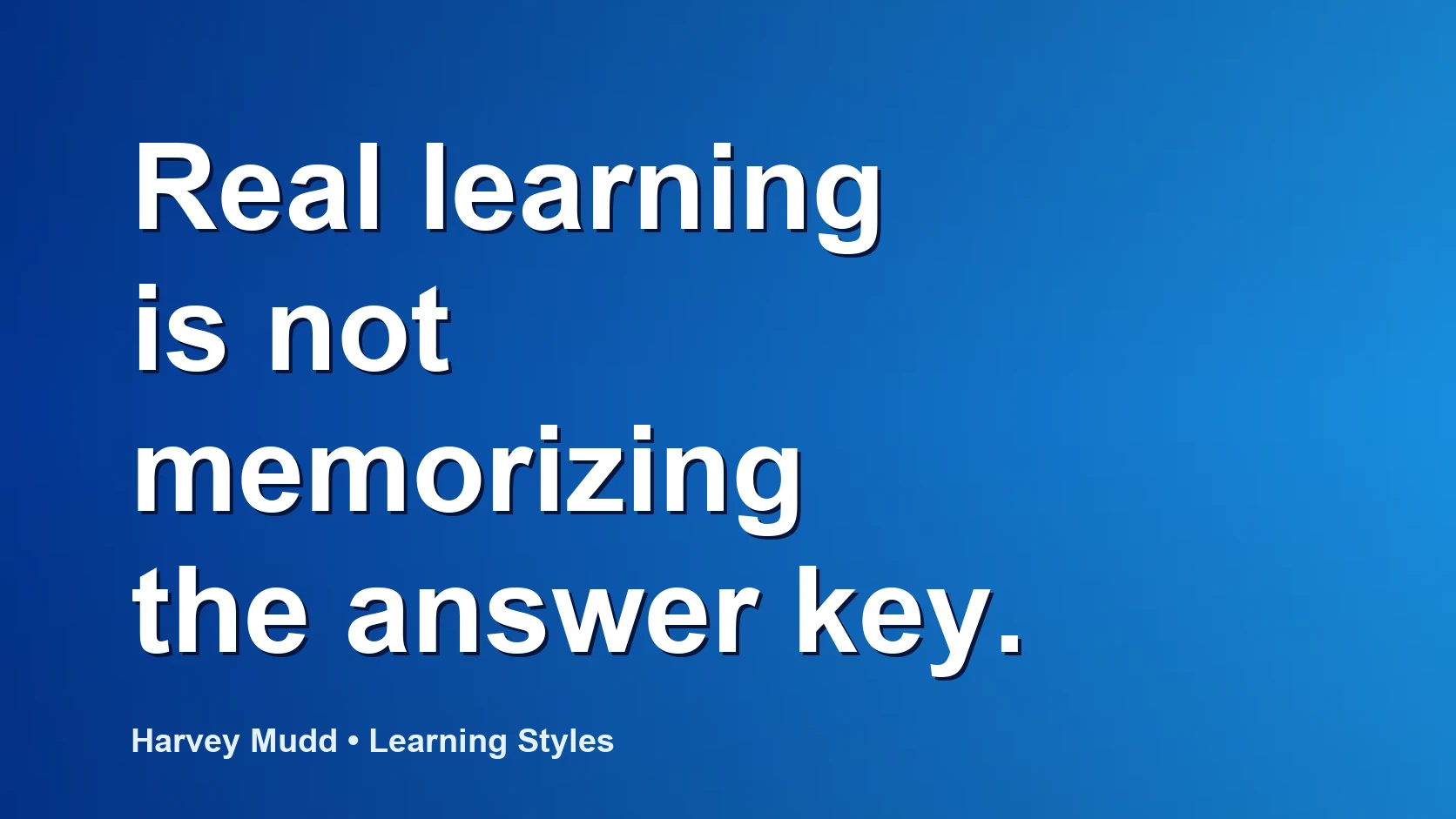
Short answer: In video 7, "Different Learning Styles," a perspective from Harvey Mudd College emphasizes that real learning is not memorizing a standard answer — it is learning how to learn, and arriving at an answer on your own when no answer key exists. Open-ended projects give different kinds of learners a chance to succeed, and Harvey Mudd often reminds people that STEM without a sense of humanity is not the goal. This article is based on the public LJCDS Advanced Studies / The College Perspective series materials; it is not an exclusive EdComm interview.
Welcome back, parents and students.
In the previous piece, we talked about this idea: the abilities that will really matter in the future are not the ones that serve a test — they are reading, writing, discussion, critical thinking, and interdisciplinary learning.
Video 7, "Different Learning Styles," takes that question back into the classroom:
If we are not teaching only for the standard answer, how should students actually learn?
This section comes from a Harvey Mudd College perspective, and it is well worth a close read for families on a STEM path.
This article is based on the LJCDS Advanced Studies / The College Perspective series; it is compiled from publicly available material and is not an exclusive EdComm interview. This piece summarizes video 7, "Different Learning Styles," and adds EdComm's read on how Chinese-American families can plan high school coursework.
This piece focuses on three questions: why top STEM schools like Harvey Mudd value open-ended learning; how project-based learning helps different kinds of learners succeed; and why a STEM application cannot leave out the human and social dimension.
Background: many students are good at finding answers, but not at facing questions with no answer
In traditional learning, students are most familiar with:
- the teacher explains a concept;
- homework drills the problem type;
- the exam asks for the standard answer;
- mistakes get corrected toward the right answer.
This system can build foundational skills, but it has a limit: real-world problems usually do not have an "answer at the back of the book."
This is especially true in STEM, where students will eventually face problems that are not pre-organized exercises — they are ambiguous, complex, constrained, ethically loaded, and full of people.
The admissions officer says
This is not rote memorization — it is learning how to learn; it is learning to arrive at an answer on your own when there is no answer key. Open-ended projects let different kinds of learners succeed. — Paraphrased from the subtitles of video 7, "Different Learning Styles"
The video also mentions something Harvey Mudd often emphasizes: STEM without humanity is worse than no technology at all.
STEM without a sense of humanity can be worse than having no technology at all.
That line is very Harvey Mudd, and it is well worth taking to heart for Chinese families too.
EdComm's read: top STEM education is not looking for a problem-drilling machine
Many families understand the STEM path as: strong in math, strong in physics, strong in coding, strong in competitions.
Those are, of course, important foundations. But genuinely top STEM education also looks at whether a student can:
- face open-ended problems;
- collaborate with people from different backgrounds;
- explain their own reasoning;
- understand the social impact of technology;
- keep making progress when there is no standard answer.
Project-based learning, open-ended research, and interdisciplinary discussion are not "soft." They train students to handle real problems.
Three reminders for Chinese-American families
1. Do not reward only the child who finds the standard answer fastest
Many children are trained from a young age to be very good at exams, but freeze the moment they meet an open-ended problem.
That is because an open-ended problem has no single answer and no clear steps. It asks the student to define the problem, propose a hypothesis, test a path, and explain the result.
This kind of ability has to be deliberately trained during the high school years.
2. Do not leave the human dimension out of a STEM application
If a student applies to engineering, computer science, or data science, but all of their materials contain only technology — no people, no social problem, no sense of ethics — the narrative will feel thin.
Schools like Harvey Mudd care in particular that technology should ultimately serve society.
3. Different learners can show ability in different ways
Some students are good at exams, some are good at projects, some are good at discussion, and some are good at making complex ideas clear.
Good education should not allow only one path to success. Good application planning should also help a child find the form of evidence that shows them at their best.
FAQ
Why does Harvey Mudd emphasize open-ended learning?
Because real STEM problems often have no standard answer. Open-ended projects train students to define problems, find a path, collaborate, iterate, and express their thinking.
Why do STEM students need a sense of humanity?
Technology affects real people and real society. STEM without a human dimension can produce solutions that are highly efficient but pointed in the wrong direction.
Does project-based learning help an application?
If a project has a real problem, a clear process, reflection, and an output, it helps a great deal. It shows how a student learns and solves problems, not just test scores.
Series navigation
Related reading
Michigan Admissions: No AP Is Not a Disadvantage by Itself
In video 8, Michigan admissions explains that no AP is not a disadvantage by itself; colleges evaluate subject preparation, rigor, sequencing, and context.
Admissions Officers on Future Skills: Do Not Teach Only to the Test
Video 6 emphasizes future-ready skills: close reading, writing, debate, critical thinking, and flexible learning across disciplines.
Admissions Officers: AP Is a Brand; Rigor Is the Real Question
Video 5 explains that AP is ultimately a brand. Colleges care about actual rigor, not only the label attached to a course.